North Logiealmond Wind Farm
Design and Access Statement
1. Introduction
1.1 The purpose of the Design and Access Statement (DAS)
A Design and Access Statement (DAS) is a short report that accompanies a planning application. It provides a framework for applicants to explain how a proposed development has considered design and access arrangements. A DAS is required for planning applications for major development and other specific circumstances. There is no statutory requirement for a DAS to support a Section 36 application. However, one has been prepared to ensure the iterative design process is communicated to the reader in a clear and transparent way. Where relevant, consideration has also been given to Planning Advice Note 68: Design Statements1 (PAN 68), which sets out key principles to be considered for a DAS.
This DAS is submitted in support of the Section 36 application under the terms of the Electricity Act 1989 for consent to construct, operate and decommission the North Logiealmond Wind Farm (the Proposed Development) on land within the North Logiealmond Estate, part of Scone Estates, in Perthshire.
The DAS is part of a wider suite of documents to accompany the application submission, which includes:
Planning and Renewable Energy Statement;
Environmental Impact Assessment Report (EIAR);
Pre-Application Consultation (PAC) Report;
Draft Conditions;
Socio-Economics, Tourism and Recreation Report; and
Marine Scotland Science Checklist.
In particular, the DAS should be read in conjunction with EIAR Chapter 3: Site Selection and Design Evolution and EIAR Chapter 4: Project Description, which provides a more detailed description of the final design and layout of the Proposed Development.
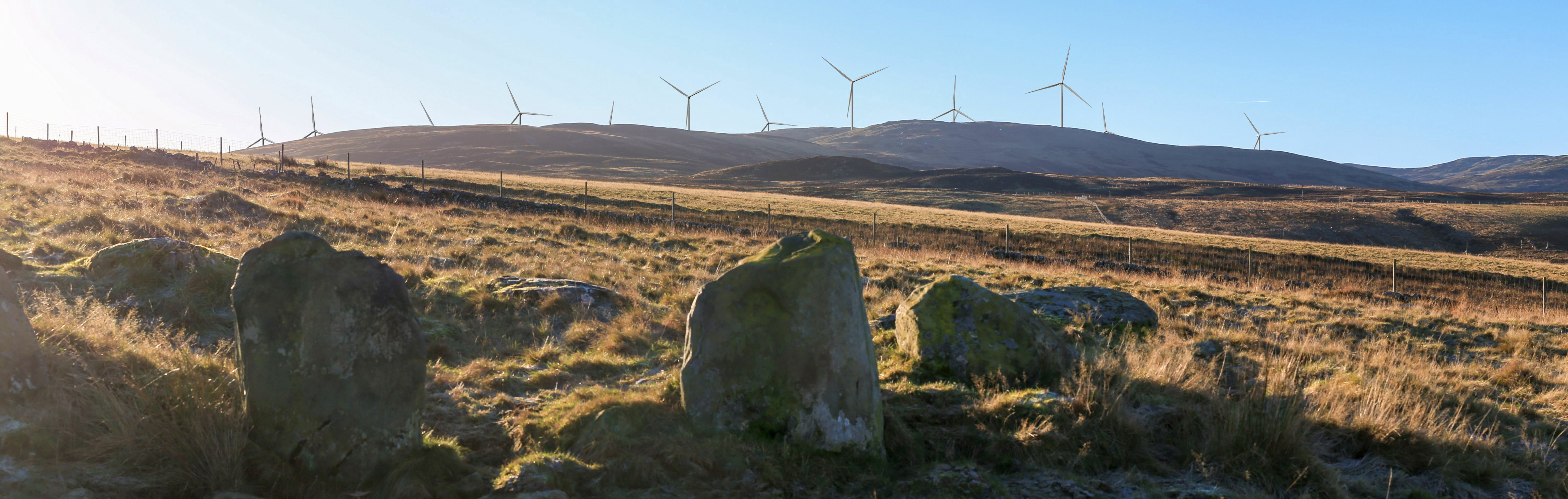
This DAS will set out the design principles that have been used to inform the iterative design process for the Proposed Development. It will demonstrate how the Proposed Development has taken account of the Site constraints, nearby sensitive receptors, the wider landscape and access implications and how these considerations have influenced the design.
1.2 The Applicant and the Consultant
This Design and Access Statement (DAS) has been prepared by Natural Power Consultants Ltd (Natural Power), on behalf of North Logiealmond Wind Farm Limited (hereafter ‘the Applicant’).
The Applicant is a ‘Special Purpose Vehicle’ of Muirhall Energy Limited. Muirhall Energy is an independent renewable energy developer based in Lanarkshire. Led and managed by a dynamic and experienced team, the company has constructed more than 150 MW of onshore wind capacity, with a further 1.2 gigawatts (GW) of renewable energy projects consented or in planning and in excess of 3GW in early-stage development across Scotland, England and Wales. Further details are available on the company website: www.muirhallenergy.co.uk
1.3 Consenting route
As the Applicant is submitting an application for the Proposed Development under Section 36 of the Electricity Act 1989 (known as a Section 36 application), the installed capacity of the Proposed Development would exceed 50 megawatts (MW). The Applicant is seeking consent to construct, operate and decommission a wind farm comprising up to 13 turbines with an installed capacity of up to 93.6 MW.
To accompany the application, the Applicant has undertaken an Environmental Impact Assessment (EIA) and produced its findings in the Environmental Impact Assessment Report (EIAR). The EIAR provides a detailed description of the Proposed Development, assesses its likely significant environmental effects and identifies measures to avoid, reduce or mitigate potential impacts of the site preparation, construction, operation and decommissioning. Notwithstanding this, a description of the Proposed Development is set out in Section 2.
1.4 The structure of the DAS
This DAS is structured as follows:
Chapter 1: Introduction – this sets out the purpose of the DAS, and a structure for the document.
Chapter 2: The Proposed Development - this provides a description of the Proposed Development, including details of its location, relevant planning history, identified site constraints, and a summary of consultation and stakeholder engagement.
Chapter 3: Design Policies – summarises policies and guidance relating to wind farm design which have been considered during the iterative design process for the Proposed Development.
Chapter 4: Design Principles – sets out the key design principles that were followed as much as practicable to inform the iterative design process.
Chapter 5: Design Evolution – outlines the evolution of the Proposed Development through the consideration of alternatives and iterative design refinements. It includes details of key design decisions, such as the use and location of borrow pits, and the application of micrositing principles.
Chapter 6: Access – this section describes the approach to site access, including the offsite access routes to the Proposed Development, the layout and design of onsite access tracks, provisions for public access, and arrangements for onsite vehicular access.
Chapter 7: Conclusion - summarises the evolution of the design, incorporating environmental constraints, considerations and consultation feedback and demonstrates how these have informed the final layout of the Proposed Development.