North Logiealmond Wind Farm
Design and Access Statement
3. Design Policies
This section summarises policies relating to wind farm design which have been considered during the iterative design process for the Proposed Development. Further information on the renewable energy and development plan policies is set out in EIA Chapter 5 Climate Change, Legislative and Policy Context and the Planning and Renewable Energy Statement.
A full assessment of the Proposed Development’s response to key land use planning, energy and climate policy is included within the Planning and Renewable Energy Statement which is submitted in support of this application and as a result the full range of energy policies and development plan policies are not repeated here.
NPF4 forms part of the statutory Development Plan. While Section 25 of the Town and Country Planning (Scotland) Act 1997 does not apply to Section 36 applications, NPF4 remains a significant material consideration. In fact, onshore wind development in excess of 50 MW is considered to be national development, where the ‘need’ for the development is already established by the Scottish Government. NPF4 establishes a spatial framework for onshore wind developments with an emphasis on protecting, restoring and enhancing natural assets.
The relevant development plan documents that relate to design are:
National Planning Framework 4 (NPF4 – adopted February 2023); and
Perth and Kinross Local Development Plan 2
The iterative design process applied to the Proposed Development has been informed by national policy, planning guidance and supplementary advice relevant to the siting and design of onshore wind developments.
Other guidance includes:
Planning Advice Notes (PANs); and
Onshore Wind Turbines: Planning Advice (Scottish Government, 2024)
NatureScot’s Siting and Designing Wind Farms in the Landscape (Version 3a, 2017);
3.1 National Policy
Policy 11 Energy of NPF4 sets out the spatial framework within which windfarms are assessed and is based on the following overreaching policy direction:
Development proposal for winds farms in National Parks and National Scenic Areas will not be supported;
Development proposals will only be supported where they maximise net economic impact, including local and community socio-economic benefits such as employment, associated business and supply chain opportunities;
Development proposals that impact on international or national designations will be assessed in relation to Policy 4; and
Project design and mitigation will demonstrate how the following impacts are addressed:
Impacts on communities and individual dwellings, including, residential amenity, visual impact, noise and shadow flicker;
Significant landscape and visual impacts, recognising that such impacts are to be expected for some forms of renewable energy. Where impacts are localised and /or appropriate design mitigation has been applied, they will generally be considered to be acceptable;
Public access, including impact on long distance walking and cycling routes and scenic routes;
Impacts on aviation and defence interests, including seismological recording;
Impacts on telecommunications and broadcasting installations, particularly ensuring that transmission links are not compromised;
Impacts on road traffic and on adjacent trunk roads, including during construction;
Impacts on historic environment;
Effects on hydrology, the water environment and flood risk;
Biodiversity, including impacts on birds;
Impacts on trees, woods and forests;
Proposals for the decommissioning of developments, including ancillary infrastructure, and site restoration;
The quality of site restoration plans, including the measures in place to safeguard or guarantee the availability of finances to effectively implement those plans; and
Cumulative impacts.
In considering these impacts, significant weight will be placed on the contribution of the proposal to renewable energy generation targets and on greenhouse gas emissions reduction targets.
3.2 Local Policy
The Perth & Kinross Local Development Plan 2 LDP2 is the Local Development Plan (LDP) for the Site. It was adopted on 29 November 2019 and, together with NPF4, forms the statutory planning policy framework guiding future developments within the Perth & Kinross Council area.
As such, its policies, particularly those related to renewable and low carbon energy are highly relevant. However, while LDP2 remains in force, policies within NPF4 may carry greater weight where there is any conflict between the two.
The LDP2 framework directs development across Perth & Kinross through to around 2029. It emphasises sustainable development and climate action, aligning with its objective of “promoting sustainable economic growth and sustainable development, building upon the special qualities of our area”.
LDP2 explicitly recognises the urgency of addressing climate change and sets out policies supporting renewable energy, including the following:
Policy 33 of LDP2 (“Renewable and Low-Carbon Energy”) supports proposals that meet detailed criteria, including environmental impact, community benefit, grid and transport infrastructure, decommissioning, and energy storage opportunities.
In addition, Perth & Kinross Council has published draft Renewable & Low Carbon Energy Planning Guidance (2025), supported by technical studies (including landscape capacity assessments, SEA screening), to support the interpretation and application of NPF4 Policy 11 and LDP Policy 33. These documents provide detailed guidance for developers on wind, hydro, solar, storage, biomass, and co-located technologies.
The Council has recently consulted on the LDP3, however, owing to the early stage of the development of the LDP3, it is not considered further in this DAS.
3.3 Other relevant documentation
The Construction (Design and Management) (CDM) Regulations 2015
Schedule 9 of The Construction (Design and Management) (CDM) Regulations 2015 sets out legal design requirements that must be considered during design. The general principles of prevention and any pre-construction information are to eliminate, so far as is reasonably practicable, foreseeable risks to the health or safety of any person:
carrying out or liable to be affected by construction work;
maintaining or cleaning a structure; or
using a structure designed as a workplace.
Where it was not possible to eliminate these risks, the designer, so far as is reasonably practicable, should take steps to reduce or control the risks through the subsequent design process.
The Onshore Wind Turbines: Planning Advice
The Onshore Wind Turbines: Planning Advice, published by the Scottish Government in 2014, provides an overview of common issues which need to be considered and some guidance on how to assess these in order to inform onshore wind design. This guidance was withdrawn in December 2025. However, it was used to inform the iterative design process up to that point. The advice relating to onshore wind design, such as landscape assessment, shadow flicker analysis, noise potential, impacts on wildlife and more.
Land Use Planning System SEPA Guidance Note 31
This guidance sets out (amongst other things) the stand off distances required for wind farm development from water features.
Siting and Designing Wind Farms in the Landscape
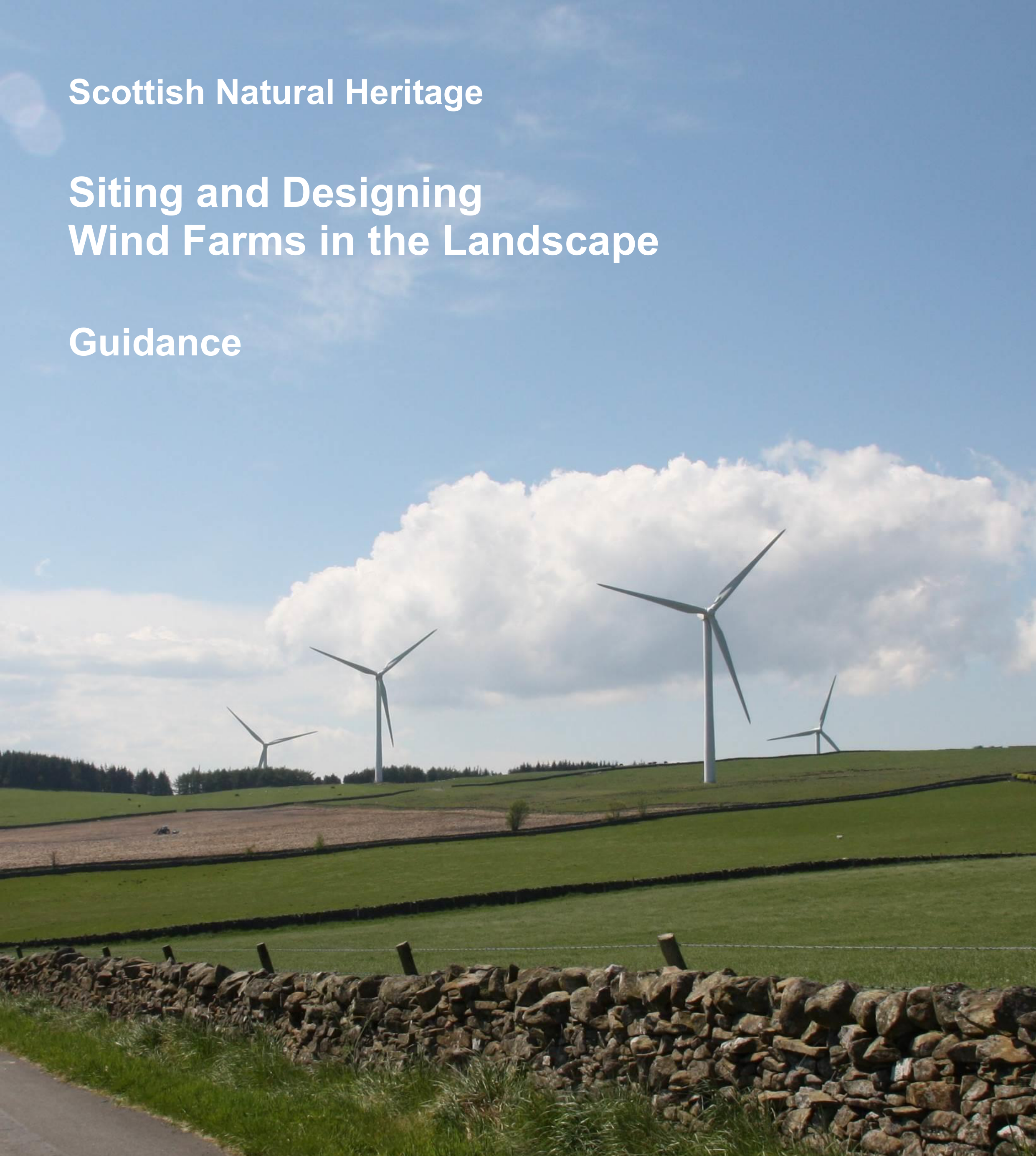
Siting and Designing Wind Farms in the Landscape helps to guide wind farms towards those landscapes most able to accommodate them. It sets out how wind farms can be designed to best relate to their setting and to minimise landscape and visual impacts.
Assessing the Cumulative Impact of onshore wind energy development
This document confirms that renewable energy is an increasingly important part of Scotland’s economic, social and environmental success. The pace of renewable developments has increased rapidly in recent years, and wind farms are now familiar sights in many parts of the country. NatureScot acknowledges and supports the development of wind farms and recognises the many benefits they bring. However, the cumulative impacts on nature and landscapes need to be carefully considered, and the guidance sets out NatureScot’s advice on assessing cumulative landscape and visual impacts.
Guidance on Aviation Lighting Impact Assessment
This guidance brings consistency to the assessment process for visible aviation lighting. It advises on the level of detail and content that is expected in support of applications, while providing decision makers and consultees with a framework for assessing impacts.